Niklas's thoughts

book

mountain

I'm nearly a fifth into The Magic Mountain, which I've written more about in this post. The edition I'm reading is translated by Simon Pare; he keeps a blog that he wrote about his translation work, which he did during 2024. The blog is named A Year on the Magic Mountain.

Here's the start of the book:

Arrival

An ordinary young man was travelling in midsummer from his home town of Hamburg to Davos-Platz in the Grisons region of Switzerland. He planned to visit for three weeks.

Yet it is a long journey from Hamburg to these mountains-too long a journey, in truth, for such a short stay. It leads through many different regions, uphill and down, descending from the south German plateau to the shores of the Swabian Sea and by ship across its leaping waves, over abysses once thought to be unfathomable.

Here, a journey that has so far proceeded smoothly and directly becomes fragmented. There are stops and disruptions. In a place called Rorschach, on the Swiss side, you once more entrust your progress to the railway, but only as far as Landquart, a small Alpine station where you are obliged to change trains. After standing around for some time in windy and rather unattractive surroundings, you board a narrow-gauge railway, and as the small yet uncommonly powerful locomotive pulls away, so the truly adventurous part of the journey begins, an abrupt and arduous climb that seems to go on for ever. For Landquart station lies at a middling altitude; now, though, the wild and rocky route forges up tenaciously towards the high peaks.

Hans Castorp for that is the young man's name-sat alone in a small, grey-upholstered compartment with his crocodile-skin bag (a gift from his uncle and guardian Consul Tienappel, whom we may as well introduce at this point), his winter coat, which was swaying from a peg, and his tartan blanket-roll. He was sitting with the window wound down, and since the afternoon was cooling fast, this cosseted, delicate boy had turned up the collar of his fashionably loose, silk-lined summer topcoat. On the seat beside him lay a paperbound book entitled Ocean Steamships, which he had dipped into earlier in his journey, but now it lay there ignored, while puffs of steam streaming in from the heavily panting locomotive speckled its cover with particles of soot.

***

Here's a great paragraph that I read this morning. Mind you, a lot of what I've read so far in the book are recollections, fragments, and inner workings that deal with conversations between people at one specific place.

Many ridiculous ideas have been disseminated about the nature of boredom. It is generally believed that interesting and novel ingredients help to 'pass' the time, meaning that they abbreviate it, whereas monotony and emptiness clog and block its course. That is not necessarily accurate. Emptiness and monotony may well stretch for a moment or an hour, leading to 'boredom', but they abbreviate larger magnitudes of time, the largest too, and can even dissolve them into nothing. Conversely, abundant and interesting content is very much capable of abbreviating and enriching an hour and even a day, but when scaled up it lends depth and weight and solidity to the passage of time, and as a result eventful years pass far more slowly than the meagre, empty, and flimsy ones the wind carries before it so that they fly past. What we call boredom is therefore actually more like a pathological, monotony-induced absorption in time; uninterrupted homogeneity shrinks great vistas of time in heart-chilling fashion; if one day is like every other, they are all the same, and the effect of perfect uniformity is that even the longest life would appear very short and be gone in the twinkling of an eye. Growing familiarity causes a dulling or blunting of our sense of time, and if we have the sensation that the years of our youth pass slowly and yet later life proceeds more and more swiftly, rushing past us, then familiarity must be the cause. We know that the addition of adjustments and new habits is the only way to control our lives, freshen up our sense of time, and bring about a rejuvenation, intensification, and deceleration of our experience of it-and with it a regeneration of our whole sense of being alive. That explains why we seek a change of scene and a change of air, why we go to the seaside and crave the relaxing effect of variety and the episodic. The first days in a new place have a youthful feel, a sense of force and breadth-we are talking about a period of between three and eight days. Then, as we 'settle in', there is a gradual and perceptible shortening: anyone who clings on to life-or, rather, would like to cling on to life-may become grimly aware of how the days begin to lose their density and race past again; the last week of four, say, is eerily fast-moving and brief. Admittedly, the refreshment of our sense of time continues beyond the interlude and, when we have returned to normal, asserts itself once more: the first days at home after the change once more have a newly spacious and youthful feel, but this ceases after a few days because we adapt faster to the rule than to the exception, and if our sense of time has been dulled by age or-a mark of an innate lack of life force-was not very highly developed in the first place, it very quickly fades and after only twenty-four hours it is as if we had never been away, as if our trip were the dream of a single night.
#book #reading #ThomasMann

wildatheart

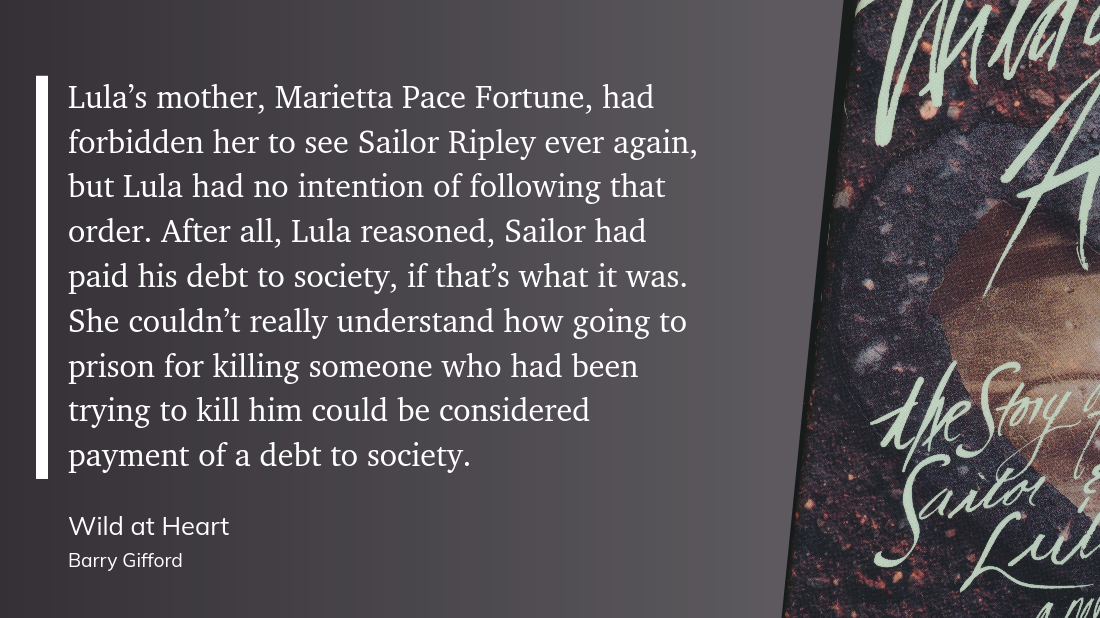
Here's a book: Wild at Heart.

Yes, it's the book on which David Lynch based his film.

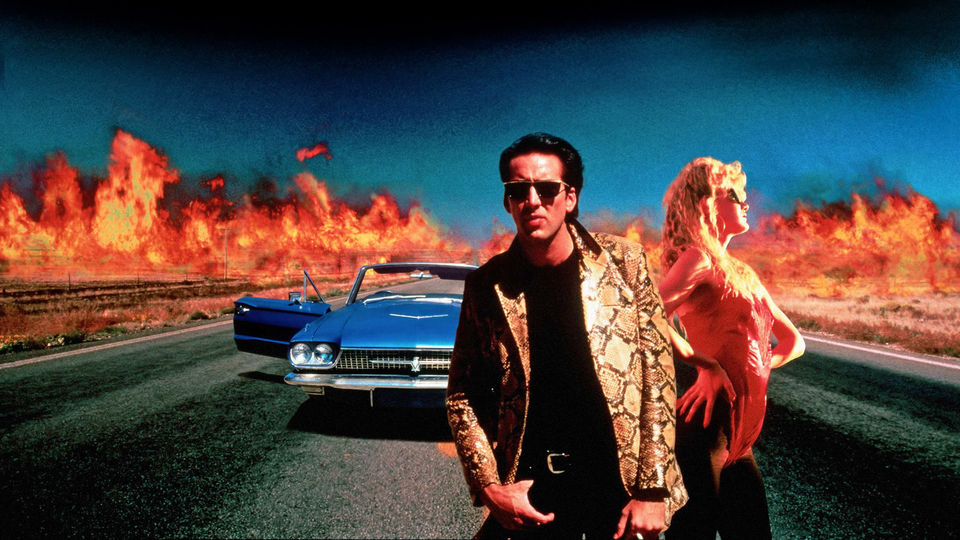
wildatheart Nicolas Cage and Laura Dern in Wild at Heart, the film, as Sailor and Lula, respectively.

The book is much more than the film; they complement each other. I've read half of the book; it's a very quick read. The language is swift, simple, without darlings. Although, I must confess, there's so much heat from the book in the form of attraction, humour, The Inevitable (à la God)...it's great, so far.

Here are some quotes from the book, and may people buy shitloads of books off Barry Gifford, the wonderful author, because he deserves all the best.

The world is really wild at heart and weird on top, Lula thought. Anyway, Sailor was out now and he was still the best kisser she’d ever known, and what Mrs. Marietta Pace Fortune didn’t find out about wasn’t about to hurt her, was it?

***

“My daddy was livin’ with his mama when he died,” said Sailor.

“Did you know that?” Lula shook her head.

“I surely did not,” she said.

“What were the circumstances?”

“He was broke, as usual,” Sailor said. “My mama was already dead by then from the lung cancer.”

“What brand did she smoke?” asked Lula.

“Camels. Same as me.”

***

“I’d stand by you, Sailor,” Lula said. “If you were an embezzler.”

“Hell, peanut,” Sailor said, “you stuck with me after I’d planted Bob Ray Lemon. A man can’t ask for more than that.”

Lula pulled Sailor over to her and kissed him soft on the mouth.

“You move me, Sailor, you really do,” she said. “You mark me the deepest.”

Sailor pulled down the sheet, exposing Lula’s breasts.

“You’re perfect for me, too,” he said.

***

“Sailor?”

“Honey?”

“Ever imagine what it'd be like to get eaten alive by a wild beast?”

“Mean a tiger?”

“Yeah. Sometimes I think it'd be the biggest thrill?”

Sailor laughed. “It better be, darlin', 'cause it'd be the last.”

“Ripped apart by a gorilla, maybe,” said Lula.

“How about bein' squeezed to death by a python?”

Lula shook her head. “I don't think so. That might be way too slow? And you'd feel your ribs crackin' and insides oozin' out. I'd rather get grabbed sudden and pulled apart quick by a real powerful animal.”

“Lula, sometimes I gotta admit you come up with some weird thoughts.”

“Anythin' interestin' in the world come out of somebody's weird thoughts, Sailor. Couldn't have been no simple soul dreamed up voodoo, for an instance.”

“Voodoo?”

“Sure. How else you explain stickin' pins in dolls to make a person squirm or have a heart attack? Or cookin' someone's fingernail clippin's to make 'em vomit till they ain't got nothin' left inside and drop dead. You tell me, Sailor, who could come up with shit like that ain't super weird?”

“You got me, peanut.”

“You certain?”

“I ain't never met anyone come close to you, sugar.”

Lula rolled over on top of Sailor.

“Take a bite of Lula,” she said.

#book #reading #BarryGifford

dangerous|350x531

Here's a wonderful quote about change, to suddenly decide to do the right thing.

The quote is from the remarkable new book Dangerous, Dirty, Violent, and Young: My Fugitive Family in the Revolutionary Underground by Zayd Ayers Dohrn:

My mother was already leaving the law behind. But King's protest wasn't the only experience that changed her that summer. Another chance meeting seems to have solidified her conviction that direct action, rather than legal study, was her best path forward.

One 102-degree day in July, Bernardine was at the church that served as headquarters for King's rent strike, working on a legal appeal, when somebody shouted, “There's an eviction two blocks away!” My mother and a few other legal advisors grabbed their armbands and ran outside, to find a group of sheriff's deputies carrying someone's belongings out of an apartment and dumping them onto the sidewalk.

“Nobody's shouting,” my mother remembers. “Nobody's saying anything. But they're dumping the kitchen table, children's clothing, toys, dresser drawers everything is piling up in the street.”

Suddenly, she felt somebody next to her-a presence that felt unusually imposing. A man turned to her and asked, “Would you hold my suit coat?”

“And it's Muhammad Ali!” she says, laughing. “The most recognizable person-along with Dr. King-in the world at the time! How did he get there? I have no idea. How did he know to come? Who called him?”

Ali handed her a blue, silk-lined seersucker coat, stepped forward, and picked up a kitchen table. He turned without a word, walked into the apartment building, and started up the stairs. “Instantly,” my mom remembers, “everybody, of the one hundred or two hundred of us standing around, picks up something and follows him inside.”

The deputies just stood there watching while the crowd put the person's apartment back together, piece by piece. “And that was it!” she says. “It was a people power moment. It was a moment of defiance, a gesture by somebody who could carry it off with such panache and so little fear. And it just gave everybody a spark of what's possible.

“And it was that combination-seeing King, night after night, speaking in churches, out there on the West Side-and then these marches on the weekends... It was all so powerful and so brilliant. It changed my life.

#book #reading #change #life #revolution

Königsberg

The book has an intriguing intro:

Between 1835 and 1842, scandal tightened around two clergymen in the Baltic port city of Königsberg. It destroyed their reputations, drove them out of their jobs and into prison, and banished them from public life. Their legal exoneration of the most serious charges against them came too late to reverse the damage. I have been thinking about this small vortex of turbulence ever since I happened on the relevant files in the early 1990s. The campaign of denunciations and rumour that took down the Lutheran preachers Johann Ebel and Heinrich Diestel belongs to an age before the advent of paparazzi, radio, television and digital social media, but that is precisely what endows their story with fabular power. Resemblances to present-day persons and situations, though not intended, cannot be ruled out.

Ooh! Witchy start!

The book is #1 in LitHub's best-reviewed nonfiction list for this week.

#book #reading #quote